Montreal rewards people who plan by neighbourhood rather than by landmark. The best things to do in Montreal sit in tight clusters — a 17th-century port, a mountain park in the middle of the city, a string of food streets on the Plateau, an Olympic complex out east — and the metro stitches them together in minutes. Get the geography right and three days feels like a week.
Below are 61 ideas, grouped by area so you can string them into days, each with the nearest metro station, what it costs and how long to allow. Prices are in Canadian dollars and were checked in September 2026; treat them as the right order of magnitude and confirm on the operator’s site before you go, because Montreal attractions adjust rates every season.

Things to Do in Montreal at a Glance
If you only have a weekend, this is the short list. Everything else in the guide is worth doing; these fifteen are the ones first-time visitors regret skipping.
| Attraction | Area | Nearest metro | Cost (CAD, 2026) | Allow |
|---|---|---|---|---|
| Notre-Dame Basilica | Old Montreal | Place-d’Armes (Orange) | $16 | 1 hour |
| AURA light show | Old Montreal | Place-d’Armes (Orange) | $37 + tax | 45 min |
| Pointe-à-Callière | Old Montreal | Place-d’Armes (Orange) | $30 | 2 hours |
| Old Port promenade | Old Port | Champ-de-Mars (Orange) | Free | 1–2 hours |
| Kondiaronk Belvedere | Mount Royal | Peel (Green), then walk | Free | 2 hours return |
| Saint Joseph’s Oratory | Côte-des-Neiges | Côte-des-Neiges (Blue) | Free (museum $3) | 1.5 hours |
| Montreal Museum of Fine Arts | Downtown | Guy-Concordia (Green) | $30; free 25 and under | 2–3 hours |
| Jean-Talon Market | Little Italy | De Castelnau (Blue) | Free to browse | 1.5 hours |
| Bota Bota floating spa | Old Port | Square-Victoria–OACI (Orange) | From $65 + tax | 3 hours |
| Montreal Botanical Garden | Olympic Park | Pie-IX (Green) | $25.50 | 3 hours |
| Biodome | Olympic Park | Viau (Green) | $25.50 | 1.5–2 hours |
| Habitat 67 guided tour | Cité du Havre | None; walk from the Old Port | $58 (Saturdays, Apr–Nov) | 90 min |
| Lachine Canal by bike | Southwest | Lionel-Groulx (Green/Orange) | BIXI $1.60 + 21¢/min | 2–4 hours |
| Biosphere | Parc Jean-Drapeau | Jean-Drapeau (Yellow) | $25.50 | 1.5 hours |
| A Canadiens game | Downtown | Lucien-L’Allier (Orange) | Varies widely, roughly $100–$300 | 3 hours |
Before You Start: Metro, Money and a Word About French
The STM (Société de transport de Montréal) runs four metro lines, known by colour and number: 1 Green, 2 Orange, 4 Yellow and 5 Blue. There is no Line 3; it was planned and never built. Trains run from about 05:30 until roughly 00:30, a little later on Saturday nights. A single fare is $3.75 as of 2026; a 24-hour pass is $11.25, a 3-day pass $21.75, and an unlimited weekend pass (Friday 16:00 to Monday 05:00) $17. Tap a contactless credit or debit card at the turnstile, or buy an OPUS card, the city’s reloadable transit card, for $6. Fares are set by the regional transit authority, the ARTM, which publishes the current fare schedule.
Arriving by air, ignore anything you read about taking the REM light rail from the airport. The REM does not reach Montréal–Trudeau (YUL) yet — the airport station is still under construction and targeted for the end of 2027. The 747 bus runs around the clock between the airport and downtown for $11.25, payable in cash on board, and that ticket doubles as a 24-hour pass for the whole bus and metro network.
Money is simple once you know two things. Sales tax (GST plus QST, just under 15% combined) is added at the till rather than shown on the price tag, and tipping follows US habits: 15–20% in restaurants, a dollar or two per drink at a bar. The legal drinking age in Quebec is 18.
Montreal is in the province of Quebec, and French is the official language. Quebec’s language laws, including Bill 96, govern signs and businesses, not tourists — nobody expects visitors to speak French. You will hear “Bonjour-Hi!” in shops; answer in whichever language you are comfortable with. Downtown, Old Montreal, the Plateau and Mile End switch to English without blinking. A “merci” still goes a long way.
Old Montreal and the Old Port
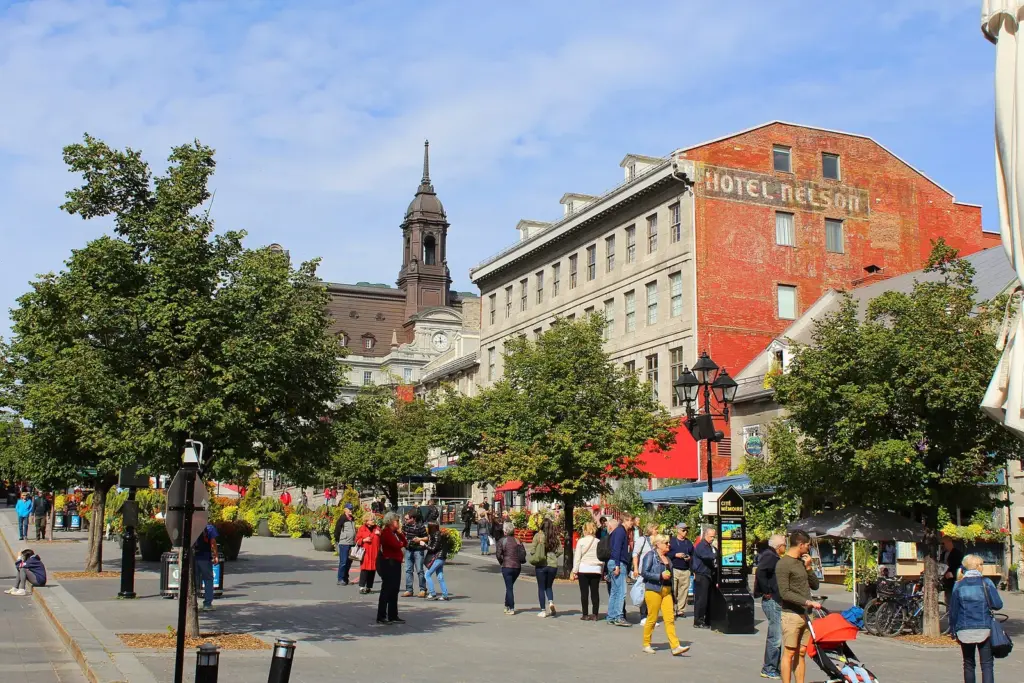
Old Montreal (Vieux-Montréal) is the walled town’s footprint between rue Saint-Antoine and the St Lawrence River, and the Old Port is its waterfront. It is the most visited part of the city and also the smallest: you can walk end to end in 20 minutes. Come early in the morning or after 18:00 in summer to see it without the cruise-ship crowds.

1. Notre-Dame Basilica
The single most impressive interior in the city. The Gothic Revival church on Place d’Armes opened in 1829, and its star-studded blue vault, carved pulpit and 7,000-pipe Casavant organ make even non-churchgoers go quiet. Its architect, James O’Donnell, was an Irish-American Protestant who converted so he could be buried in the crypt. Daytime visits include a short guided tour.
- Metro:
- Place-d’Armes (Orange), 5 minutes’ walk
- Cost:
- $16, taxes included
- Allow:
- 1 hour
2. AURA at Notre-Dame Basilica
In the evening the basilica becomes the canvas for AURA, a sound-and-light show by Moment Factory, the Montreal multimedia studio whose projection work now tours stadiums and landmarks worldwide. Light traces the ribs of the vault in time with an orchestral score, and the finale uses the whole nave. Tickets are $37 plus tax. Evening tickets are sold online or by phone only, and shows regularly sell out. Book a few days ahead in summer and around Christmas.
- Metro:
- Place-d’Armes (Orange)
- Allow:
- 45 minutes
3. Pointe-à-Callière, the archaeology museum
The best museum for understanding why Montreal exists. It is built directly over the spot where Ville-Marie was founded in 1642, and the basement walks you through the actual foundations: the first Catholic cemetery, 18th-century market stones and a vaulted 1830s collector sewer you can walk inside. A short multimedia show upstairs is surprisingly good. It is a National Historic Site. Adult admission is $30, taxes included, with lower prices for adults under 31 and seniors.
- Metro:
- Place-d’Armes or Square-Victoria–OACI (Orange)
- Allow:
- 2 hours
4. Rue Saint-Paul and Place Jacques-Cartier
Rue Saint-Paul is the oldest street in the city, cobbled and lined with 19th-century stone warehouses turned boutiques and galleries. It runs into Place Jacques-Cartier, the sloping square of street performers and flower sellers that climbs to City Hall — where Charles de Gaulle shouted “Vive le Québec libre” from the balcony in 1967. You may read about horse-drawn calèche rides here in older guides; the city banned them in 2020 and the trade has ended.
- Metro:
- Champ-de-Mars (Orange)
- Cost:
- Free
- Allow:
- 1 hour
5. Notre-Dame-de-Bon-Secours Chapel
Known locally as the sailors’ church, this small chapel at the east end of rue Saint-Paul has model ships hanging from the ceiling, left by sailors who survived the crossing. The adjoining Marguerite-Bourgeoys Museum tells the story of the woman who founded the chapel in 1655 and ran the colony’s first school, and it includes access to the tower for a view over the port. The chapel is free; the museum costs $16.
- Metro:
- Champ-de-Mars (Orange)
- Allow:
- 45 minutes
6. Château Ramezay
A low stone governor’s house from 1705, and one of the oldest buildings on the island. During the American invasion of 1775–76 it served as headquarters for the Continental Army, and Benjamin Franklin stayed here trying, and failing, to talk Quebec into joining the revolution. The period rooms are modest; the 18th-century-style kitchen garden behind is lovely in summer. Admission is $14.99 including tax, 10:00–17:00 daily.
- Metro:
- Champ-de-Mars (Orange)
- Allow:
- 1 hour
7. Bonsecours Market
The long silver-domed building facing the river was the city’s main public market and briefly its City Hall. Today it holds boutiques selling Quebec-made clothing, jewellery and design, plus a couple of restaurants. It is the better place for a souvenir than the Old Port’s T-shirt shops, which sell the same maple-leaf goods you can get anywhere.
- Metro:
- Champ-de-Mars (Orange)
- Cost:
- Free to browse
- Allow:
- 30 minutes

8. The Old Port promenade and the Clock Tower
Walk the 2.5-kilometre riverside promenade from the Science Centre to the Clock Tower, a 1922 memorial to merchant sailors lost in the First World War. At its foot, Clock Tower Beach (Plage de l’Horloge) has sand, blue parasols and Adirondack chairs facing the Jacques-Cartier Bridge — there is no swimming, but it is the best free sit-down in Old Montreal. After dark the bridge’s colour-changing lights run through the seasons.
- Metro:
- Champ-de-Mars (Orange)
- Cost:
- Free
- Allow:
- 1–2 hours
9. La Grande Roue de Montréal
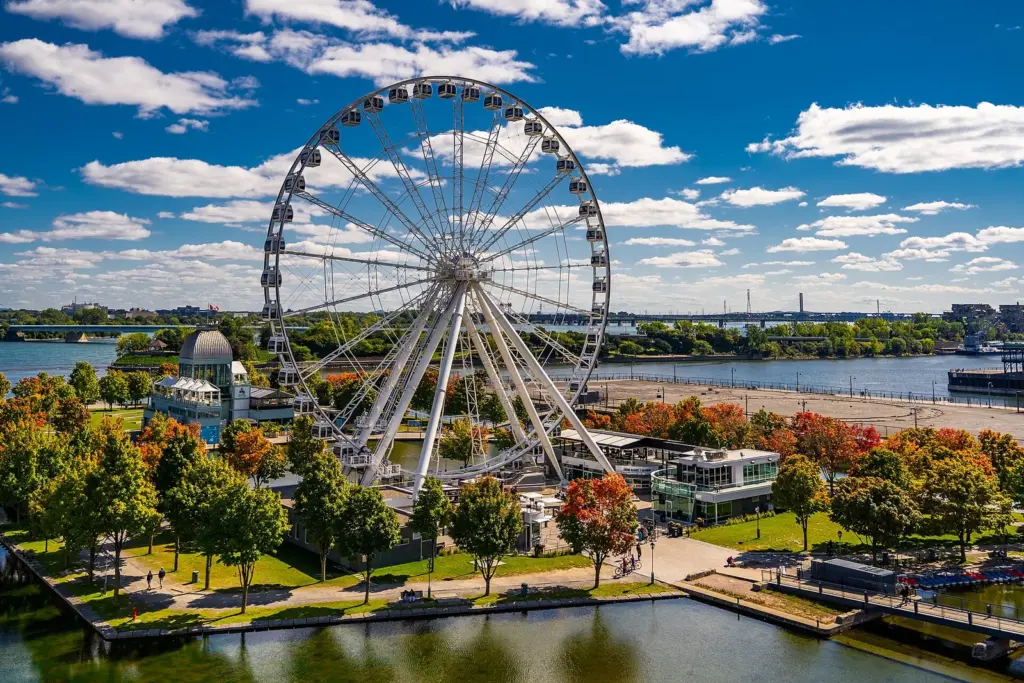
Canada’s tallest observation wheel, about 60 metres high, with heated and air-conditioned gondolas that run year-round. The ride is roughly 15 to 20 minutes. It is fun rather than essential — the free Kondiaronk Belvedere has the better view — but at sunset, looking down the river and across the Old Port rooftops, it earns its place. Tickets are $29.50 plus tax, and it turns from 10:00 to 23:00.
- Metro:
- Champ-de-Mars (Orange)
- Allow:
- 30 minutes
10. Bota Bota, the floating spa
A 1950s ferry moored in the Old Port and converted into a Nordic spa: hot pools, saunas, cold plunges and sun decks with the city skyline behind them. The thermal circuit — hot, cold, rest, repeat — is the Quebec way to spend an afternoon, and it is best in the snow. The water circuit costs from $65 for two hours to $155 for a full day, before tax, depending on the date, and it is for adults 18 and over. Book a slot ahead on weekends.
- Metro:
- Square-Victoria–OACI (Orange)
- Allow:
- 3 hours
11. Montreal Science Centre
Hands-on exhibitions and an IMAX screen on King Edward Pier. It is aimed at children and teenagers, and on a rainy day with kids it is the obvious move in Old Montreal. Adults without children can skip it. Adult admission to the exhibitions is $37.
- Metro:
- Place-d’Armes (Orange)
- Allow:
- 2–3 hours
12. Jet boating the Lachine Rapids
The St Lawrence churns through the Lachine Rapids just upstream of the Old Port, and Saute-Moutons runs open jet boats straight into the standing waves. You will be soaked to the skin — they supply rain gear, and it barely helps. It is the one Old Port activity that locals actually recommend to visiting friends. The ride lasts about an hour and runs from spring to fall; check the current fare when you book.
- Metro:
- Champ-de-Mars (Orange)
- Allow:
- 1.5 hours including kit-up
13. Habitat 67 and the river surfers
Moshe Safdie’s stacked-concrete housing complex, built for Expo 67, is still one of the most photographed buildings in Canada. It is private homes, so most people view it from avenue Pierre-Dupuy on the Cité du Havre peninsula, a 25–30 minute walk or 10-minute bike ride from the Old Port. Continue a few minutes past it in summer to watch surfers riding a permanent standing wave in the river. To see inside, Habitat 67 runs 90-minute guided tours on Saturdays from April to November — $58 in 2026, booked online.
- Metro:
- none close; walk or cycle from the Old Port
- Allow:
- 1 hour
Downtown: Museums, Cathedrals and the Underground
Downtown (centre-ville) runs roughly from the foot of Mount Royal down to Old Montreal, with rue Sainte-Catherine as its spine. It is where the museums, shopping and hockey live. Almost everything here is within 10 minutes of a Green line station.
14. Montreal Museum of Fine Arts
The MMFA spreads across five pavilions on rue Sherbrooke, linked by tunnels, with serious holdings of Canadian and Quebec art, a strong decorative-arts wing and a concert hall in a converted church. The Quebec and Canadian galleries are the part you will not see anywhere else. Admission is $30, or $32 with the major exhibition, and it is free at all times for anyone 25 or under — one of the best deals in the city for students.
- Metro:
- Guy-Concordia or Peel (Green)
- Allow:
- 2–3 hours
15. McCord Stewart Museum
The city’s social-history museum, across from McGill University: costume and textiles, photography from the Notman archive, and one of the country’s more thoughtful First Nations and Inuit collections. It is small enough to see properly in an hour and a half. Tickets are $20 online or $22 at the door, and the first Sunday of the month is pay-what-you-can.
- Metro:
- McGill (Green)
- Allow:
- 1.5 hours
16. The metro’s own art
Each metro station was designed by a different architect, and many carry public art — murals, sculpture and stained glass — built into the station itself. Champ-de-Mars has Marcelle Ferron’s great walls of coloured glass, which throw light across the platform on sunny mornings; Peel is dotted with Jean-Paul Mousseau’s bright circles. One fare buys as long a gallery tour as you like, as long as you do not leave the system.
- Metro:
- Champ-de-Mars (Orange), Peel (Green)
- Cost:
- $3.75
- Allow:
- 1 hour
17. Mary Queen of the World and Christ Church cathedrals
Two cathedrals a few blocks apart make a quick, free double. Mary Queen of the World, on René-Lévesque, is a scaled-down copy of St Peter’s in Rome, complete with a baldachin over the altar. Christ Church, the Anglican cathedral on Sainte-Catherine, sits on top of a shopping mall: in the 1980s the church was held up on supports while the Promenades Cathédrale concourse was dug out underneath it.
- Metro:
- Bonaventure (Orange) and McGill (Green)
- Cost:
- Free
- Allow:
- 45 minutes for both
18. The Underground City (RÉSO), used properly
The RÉSO is about 33 kilometres of pedestrian tunnels linking metro stations, malls, office towers and hotels. What most guides do not say is that it is not one continuous underground town you can wander — it is a set of connected segments with different owners and no shared opening hours. Treat it as a winter shortcut, not an attraction: the McGill–Peel–Bonaventure stretch will get you across downtown in February without a coat.
- Metro:
- McGill, Peel or Bonaventure
- Cost:
- Free
- Allow:
- As long as it is cold
19. Rue Sainte-Catherine
About 11 kilometres long and Canada’s big commercial street. The western stretch between Guy and Saint-Laurent has the department stores — look in on Simons, the Quebec chain with the best own-label clothing — and the eastern end runs into the Village.
- Metro:
- Peel, McGill or Guy-Concordia (Green)
- Allow:
- Half a day, depending on your wallet
20. Quartier des Spectacles and Place des Arts
The entertainment district around Place des Arts has more than 80 venues in a square kilometre and turns into the city’s outdoor festival grounds every summer. Even with no ticket, it is worth an evening walk: building façades carry video projections after dark, and Place des Festivals has dancing water jets in warm weather. This is where the Jazz Festival’s free stages go up each June.
- Metro:
- Place-des-Arts or Saint-Laurent (Green)
- Cost:
- Free to wander
- Allow:
- 1 hour
21. Promenade Fleuve-Montagne
A 3.8-kilometre walking route, opened for the city’s 375th anniversary in 2017, that links the river to the mountain: from Pointe-à-Callière in Old Montreal, up through downtown and the McGill campus, to the foot of Mount Royal. It is the easiest way to see how the city fits together in a single walk, and it ends where the climb to the Kondiaronk Belvedere begins.
- Metro:
- Place-d’Armes (Orange) to start
- Cost:
- Free
- Allow:
- 1.5 hours
22. Chinatown
Compact, busy and good value, centred on the pedestrian stretch of rue De La Gauchetière between two ornamental gates. Come for dim sum at lunchtime, hand-pulled noodles or a bubble tea, and step inside one of the bakeries for a custard tart. It sits right between downtown and Old Montreal, so it slots into either day.
- Metro:
- Place-d’Armes (Orange)
- Cost:
- Free
- Allow:
- 1 hour with lunch
Mount Royal and Its Slopes
The city is named after this hill. Mount Royal Park covers more than 200 hectares and was laid out by Frederick Law Olmsted, the designer of New York’s Central Park, and inaugurated in 1876. It is Montreal’s back garden, and it is free.

23. Walk up to the Kondiaronk Belvedere
The best free thing to do in the city, and the best view of it. From the top of rue Peel, a set of switchback stairs and paths climbs to the stone terrace in front of the Mount Royal Chalet in about 25–30 minutes. The belvedere is named after the Wendat chief who helped negotiate the Great Peace of Montreal in 1701. Go at sunset, and come down the gentler Olmsted Road if your knees object to stairs.
- Metro:
- Peel (Green), then walk up rue Peel
- Cost:
- Free
- Allow:
- 2 hours return
24. The Mount Royal Cross and the summit trails
The illuminated steel cross, put up in 1924 to recall the wooden cross Maisonneuve carried up the hill in 1643, is a 10-minute walk from the chalet along a wooded path. Beyond it, the park’s trail network loops through maple and oak forest; the Camillien-Houde lookout on the east side faces the Olympic Stadium and is the spot for sunrise.
- Metro:
- Mont-Royal (Orange), then bus 11
- Cost:
- Free
- Allow:
- 1–2 hours
25. Beaver Lake (Lac aux Castors)
A small, shallow pond on the mountain’s western plateau, surrounded by lawns and picnic tables. In summer it is where families spread out; in winter it freezes into one of the prettiest free skating rinks in the city, with skate rental in the pavilion next to it.
- Metro:
- Mont-Royal (Orange), then bus 11
- Cost:
- Free
- Allow:
- 1 hour
26. The Sunday tam-tams
Every Sunday in the warm months, drummers gather around the George-Étienne Cartier monument on avenue du Parc, and by early afternoon there are hundreds of people drumming, dancing, selling jewellery and play-fighting with foam swords on the slope above. It has been happening since the 1970s and nobody organises it. It runs on Sunday afternoons from May to September.
- Metro:
- Mont-Royal (Orange) or Place-des-Arts (Green), then bus 80
- Cost:
- Free
- Allow:
- 1–2 hours

27. Saint Joseph’s Oratory
The largest church in Canada, and its copper dome is visible from half the city. It was built around the work of Brother André, a doorman credited with thousands of healings; the long front staircase has a wooden central flight that pilgrims still climb on their knees, and his heart is kept in a reliquary inside. The terrace in front of the basilica is one of the highest viewpoints in Montreal. Entry is free and the basilica is open 06:30–21:00 daily; the small museum costs $3.
- Metro:
- Côte-des-Neiges (Blue), 10 minutes’ walk
- Allow:
- 1.5 hours
28. Notre-Dame-des-Neiges Cemetery
One of the largest cemeteries in North America, spread over the mountain’s northern slope, with winding roads, mature trees and a surprisingly peaceful walking loop. Many prominent Quebecers are buried here. It connects to Mount Royal Park, so you can walk from the Oratory to the Kondiaronk Belvedere through the cemetery and the woods in about an hour.
- Metro:
- Côte-des-Neiges (Blue)
- Cost:
- Free
- Allow:
- 1 hour
The Plateau, Mile End and Little Italy
East and north of the mountain are the neighbourhoods that give Montreal its reputation. The Plateau Mont-Royal is the one with the outdoor staircases and triplexes; Mile End is its own neighbourhood to the north-west, with a different feel — bagel bakeries, record shops, a Hasidic community and the city’s densest concentration of cafés. Little Italy is north again, around the market.

29. Walk the Plateau’s staircase streets
Start at Carré Saint-Louis, a leafy square ringed by coloured Victorian houses, and walk north on the side streets between rue Saint-Denis and avenue du Parc — avenue Laval, rue Drolet, rue de Mentana. The wrought-iron spiral staircases on the house fronts were a way to keep stairwells out of heated interiors. Finish on avenue du Mont-Royal for shops and a coffee.
- Metro:
- Sherbrooke (Orange) to start, Mont-Royal (Orange) to finish
- Cost:
- Free
- Allow:
- 1.5 hours
30. The murals of boulevard Saint-Laurent
Boulevard Saint-Laurent — “the Main” — has been Montreal’s immigrant corridor for more than a century, and since 2013 the MURAL festival has turned the stretch between rue Sherbrooke and avenue du Mont-Royal into an open-air gallery. Dozens of building-sized works stay up year-round; new ones go up during the festival each June. Detour to rue Crescent downtown for the 20-storey Leonard Cohen portrait.
- Metro:
- Saint-Laurent (Green), then bus 55
- Cost:
- Free
- Allow:
- 1.5 hours
31. Smoked meat at Schwartz’s
Montreal smoked meat is brisket cured with spices for over a week, smoked and hand-sliced — somewhere between pastrami and corned beef, and better than both. Schwartz’s has been serving it since 1928 at 3895 boulevard Saint-Laurent. Order a medium-fat sandwich, fries, a pickle and a black cherry soda. The line moves quickly; the takeout counter next door moves faster.
- Metro:
- Saint-Laurent (Green), then bus 55
- Allow:
- 45 minutes plus the queue
32. The bagel face-off: Fairmount vs St-Viateur
Montreal bagels are smaller, sweeter and denser than New York’s, boiled in honey water and baked in a wood-fired oven. Two Mile End bakeries a few blocks apart have argued over who does it best for decades: Fairmount, at 74 avenue Fairmount Ouest, and St-Viateur, at 263 rue Saint-Viateur Ouest, which bakes from 06:00 to midnight every day. Buy a sesame bagel warm from each and settle it yourself.
- Metro:
- Laurier (Orange), 15 minutes’ walk
- Allow:
- 30 minutes
33. An afternoon in Mile End
Mile End is a neighbourhood for wandering rather than sightseeing. Browse Drawn & Quarterly, the bookshop of the Montreal comics publisher, on rue Bernard; drink an espresso at Café Olimpico on rue Saint-Viateur, the café that has fuelled the neighbourhood’s musicians and writers for decades; and walk under the railway on rue Saint-Laurent to see how quickly the city changes character.
- Metro:
- Laurier or Rosemont (Orange)
- Cost:
- Free
- Allow:
- 2–3 hours
34. Parc La Fontaine
The Plateau’s own park, with a long pond, shaded paths and an outdoor theatre. In summer the lawns fill with picnickers from the neighbourhood; in winter the pond becomes a free skating rink. It is a good place to see how Montrealers actually spend a Saturday.
- Metro:
- Sherbrooke (Orange), 10 minutes’ walk
- Cost:
- Free
- Allow:
- 1 hour
35. Poutine at La Banquise
Poutine is fries, squeaky cheese curds and gravy, and it was born in rural Quebec in the 1950s. La Banquise, on rue Rachel across from Parc La Fontaine, has been serving it since 1968 with dozens of topping combinations. It is open 24 hours, which makes it the classic stop after the bars close. Order the original first.
- Metro:
- Mont-Royal (Orange), 10 minutes’ walk
- Allow:
- 45 minutes

36. Jean-Talon Market
The best food market in the city and one of the best in North America. It opened in 1933 in Little Italy and is open year-round, with around 150 vendors at peak between May and November: Quebec strawberries in June, corn and tomatoes in August, apples and ice cider in the fall. Graze on samples, then eat lunch at one of the counters around the edge. Hours are 08:00–18:00 Monday to Saturday and 08:00–17:00 on Sunday; the stalls move indoors from October. Buy your souvenirs here — maple butter and ice cider — rather than in the Old Port.
- Metro:
- De Castelnau (Blue) or Jean-Talon (Orange/Blue)
- Cost:
- Free to browse
- Allow:
- 1.5 hours
37. Little Italy and Notre-Dame-de-la-Défense
Around the market, boulevard Saint-Laurent is lined with old-school espresso bars, Italian grocers and cafés with outdoor seating in summer. The parish church of Notre-Dame-de-la-Défense on rue Dante hides an odd piece of history: a 1930s ceiling fresco by Guido Nincheri that shows Benito Mussolini on horseback, painted before the war and left in place since.
- Metro:
- Jean-Talon (Orange/Blue)
- Cost:
- Free
- Allow:
- 1 hour
The Lachine Canal and the Southwest
South-west of downtown, the old industrial neighbourhoods along the Lachine Canal have become the city’s best-kept secret for food and cycling. They see a fraction of the visitors of the Plateau.

38. Cycle the Lachine Canal
The canal opened in 1825 to bypass the Lachine Rapids, closed to shipping in 1970, and reopened to pleasure boats in 2002. Its 14.5-kilometre towpath from the Old Port to Lake Saint-Louis is flat and car-free — the easiest long bike ride in the city. Rent a BIXI, the public bike-share, at any of hundreds of docks. Pricing is pay-as-you-go — $1.60 to unlock plus 21¢ a minute (36¢ on an e-bike), plus tax — and the full network runs from mid-April to mid-November, with a reduced winter service. Stop at Atwater Market halfway.
- Metro:
- Lionel-Groulx (Green/Orange) or Square-Victoria–OACI (Orange)
- Allow:
- 2–4 hours
39. Atwater Market
Smaller than Jean-Talon and prettier, in a 1933 art deco hall with a clock tower right beside the canal. Downstairs are butchers, cheese shops and bakeries; outside, in season, the farmers’ stalls. Buy a picnic here and eat it on the canal bank. It opens 09:00–18:00 on weekdays and 09:00–17:00 at weekends.
- Metro:
- Lionel-Groulx (Green/Orange), 5 minutes’ walk
- Cost:
- Free to browse
- Allow:
- 1 hour
40. Dinner in Saint-Henri
Rue Notre-Dame Ouest through Saint-Henri and Little Burgundy has become one of the city’s best restaurant strips, with wine bars, bistros and bakeries in the old shopfronts — and generally lower prices than the Plateau. Walk the stretch between Atwater and Place-Saint-Henri stations and pick whichever terrasse is full of locals.
- Metro:
- Place-Saint-Henri (Orange) or Lionel-Groulx
- Allow:
- An evening
41. Rue Wellington and the Verdun beach
Verdun, south of the canal, is where young Montrealers moved when the Plateau got expensive. Rue Wellington is pedestrianised in summer, with café and bar terrasses down the middle of the street, and the riverside urban beach, opened in 2019, has supervised swimming in summer. It is a genuinely local afternoon, 15 minutes from downtown on the Green line.
- Metro:
- De l’Église or Verdun (Green)
- Cost:
- Free
- Allow:
- Half a day
Olympic Park and Space for Life
The 1976 Olympic site in the east end holds four of the city’s big attractions within a 10-minute walk of each other. They belong to Space for Life (Espace pour la vie), which also runs the Biosphère on Parc Jean-Drapeau. Each museum costs $25.50 for an adult, taxes included, and there is no one-day combo ticket; the Space for Life Passport, $87 for a year of unlimited visits to all five, pays for itself at the fourth museum. Tickets and timed entries are on espacepourlavie.ca.

42. The Olympic Stadium and the Montreal Tower
The “Big O”, nicknamed the “Big Owe” because the province took 30 years to pay it off, is a concrete shell by the French architect Roger Taillibert. Its mast is the tallest inclined tower in the world, 165 metres high and leaning at 45 degrees, with a funicular to an observation deck. Check before you make the trip for it: the observatory is closed for works and is not expected to reopen until spring 2027, and the stadium itself is off-limits in the meantime. Guided tours of the park ($23.50) run until 27 September 2026 and still include a view from the upper level.
- Metro:
- Pie-IX or Viau (Green)
- Allow:
- 30 minutes from outside
43. The Biodome
Housed in the former Olympic velodrome, the Biodome recreates several ecosystems of the Americas under one roof: a humid tropical rainforest, a Laurentian maple forest, the Gulf of St Lawrence, and sub-polar Labrador and sub-Antarctic coasts, with penguins, puffins, lynx and golden lion tamarins. It is the best rainy-day attraction in the city for families. Adult admission is $25.50, taxes included.
- Metro:
- Viau (Green)
- Allow:
- 1.5–2 hours
44. Montreal Botanical Garden
About 75 hectares, some 20 themed gardens and 10 exhibition greenhouses, across rue Sherbrooke from the stadium. The Chinese Garden, the Japanese Garden and the First Nations Garden are the three to prioritise, and the rose garden peaks in late June. Adult admission is $25.50, and in September and October the garden stays open until 21:00. In 2026 the Gardens of Light lantern event runs from 3 September to 1 November, lighting the Chinese and Japanese gardens after dark on timed tickets that also cover daytime entry.
- Metro:
- Pie-IX (Green)
- Allow:
- 3 hours
45. The Insectarium
Inside the Botanical Garden grounds, and the largest museum of its kind in North America. It reopened in 2022 after a complete rebuild designed around the insects’ point of view rather than pinned specimens in cases, with a walk-through butterfly habitat. Admission is the standard Space for Life price, $25.50.
- Metro:
- Pie-IX (Green)
- Allow:
- 1 hour
46. Rio Tinto Alcan Planetarium
Two domed theatres showing short astronomy films, one more scientific and one more immersive, plus an exhibition hall. It sits between the Biodome and Viau station, which makes it an easy add-on to a Biodome visit. Same price: $25.50 for an adult.
- Metro:
- Viau (Green)
- Allow:
- 1.5 hours
47. Rue Ontario and Marché Maisonneuve
Walk 10 minutes south of the Olympic Park into Hochelaga-Maisonneuve, a working-class neighbourhood that has quietly filled up with good bakeries, breweries and restaurants. Marché Maisonneuve, a Beaux-Arts market hall from 1914 with a fountain in front, is the smallest and least touristy of the city’s public markets.
- Metro:
- Pie-IX (Green)
- Cost:
- Free to browse
- Allow:
- 1.5 hours
Parc Jean-Drapeau: The Islands
Île Sainte-Hélène and Île Notre-Dame, the man-made island built for Expo 67, sit in the St Lawrence directly across from Old Montreal. Together they form Parc Jean-Drapeau: a green escape with a museum, an amusement park, a beach, a Formula 1 track and a casino. Take the Yellow line one stop from Berri-UQAM, or, in summer, the river shuttle from the Old Port. The shuttle ($7 a trip in 2026) runs in summer only and finished for the year on 7 September.

48. The Biosphere
Buckminster Fuller’s 76-metre geodesic sphere was the United States pavilion at Expo 67. Its acrylic skin burned away in 1976, leaving the steel lattice you see today, and it now houses a museum about climate and the environment. The building is the draw; walk around it even if you do not go in. It is part of Space for Life — $25.50 for an adult — and is closed on Mondays from September.
- Metro:
- Jean-Drapeau (Yellow), 5 minutes’ walk
- Allow:
- 1.5 hours
49. La Ronde
The Six Flags amusement park at the eastern tip of Île Sainte-Hélène, also an Expo 67 legacy. Its wooden roller coaster, Le Monstre, is one of the tallest two-track wooden coasters in the world. Day tickets start at $34.99 plus tax and fees, sold online only, and from 3 October to 1 November the park runs its Halloween Fright Fest on weekends.
- Metro:
- Jean-Drapeau (Yellow), then bus or a 20-minute walk
- Allow:
- A full day
50. Plage Jean-Doré
A sandy beach on Île Notre-Dame with filtered water, lifeguards and a view back to the skyline. It gets busy on hot weekends. Adult admission was $8.69 before tax in 2026; the season ran from 20 June to 7 September and reopens next summer.
- Metro:
- Jean-Drapeau (Yellow), then bus or a 20-minute walk
- Allow:
- Half a day
51. Ride the Circuit Gilles-Villeneuve
The Formula 1 track on Île Notre-Dame is open to cyclists, runners and in-line skaters most of the year when there is no event on. Riding a lap of the 4.36-kilometre circuit past the “Wall of Champions” — named in 1999, when three world champions crashed into it in a single race — is a free thrill for anyone who follows the sport. The race weekend itself now falls in late May.
- Metro:
- Jean-Drapeau (Yellow)
- Cost:
- Free
- Allow:
- 1 hour
52. Casino de Montréal
One of Canada’s largest casinos occupies the former French and Quebec pavilions from Expo 67, and even non-gamblers go for the architecture, the restaurants and the view of the city from the island. It is open around the clock from Friday morning until Monday at 05:00, and from 09:00 to 05:00 on other days; you must be 18 to enter.
- Metro:
- Jean-Drapeau (Yellow), then a short bus ride
- Cost:
- Free entry
- Allow:
- 1–3 hours
Montreal After Dark: Nightlife, Sport and Shows
Bars in Montreal stay open until 03:00, the latest last call of any major North American city, and the legal drinking age is 18. Pace yourself: the metro stops around 00:30, so the ride home after last call is a taxi, an Uber or a night bus.
53. Watch the Canadiens at the Bell Centre
The Canadiens have won 24 Stanley Cups, more than any other NHL team, and a game at the 21,105-seat Bell Centre — the biggest arena in the league — is the loudest night out in the city. The 2026–27 home opener is Tuesday 6 October against Carolina. Saturday games against Toronto or Boston cost the most; midweek games against Western Conference teams are typically 30–50% cheaper. The arena has a clear-bag policy and no re-entry.
- Metro:
- Lucien-L’Allier or Bonaventure (Orange)
- Allow:
- 3 hours
54. CF Montréal and the Alouettes
In summer and early fall, football of both kinds. CF Montréal plays MLS soccer at Stade Saputo, next to the Olympic Park, and the Alouettes play Canadian football — three downs, a bigger field, a livelier game than the NFL — at Percival Molson Memorial Stadium on the McGill campus, where the view of the mountain from the stands is half the point. Tickets are far cheaper and easier to get than hockey.
- Metro:
- Viau (Green) for Stade Saputo; McGill (Green) for the Alouettes
- Allow:
- 3 hours
55. A night on the Main and Saint-Denis
For bars, head to boulevard Saint-Laurent between Sherbrooke and Mont-Royal, or rue Saint-Denis in the Latin Quarter, where the terrasses are packed from May to October. Rue Crescent downtown is louder and more student-heavy. Clubs charge covers of roughly $5–$25; bars mostly do not. Order a Quebec microbrew — Dieu du Ciel, from Mile End, is the name to know.
- Metro:
- Saint-Laurent or Mont-Royal
- Allow:
- Until 03:00, if you are up to it
56. The Village
Montreal’s LGBTQ+ neighbourhood, around rue Sainte-Catherine Est near Beaudry station, is one of the largest in North America and welcomes everyone. Its bars, cabarets and drag shows are among the city’s liveliest nights out. Fierté Montréal, the largest Pride in the French-speaking world, fills it every August.
- Metro:
- Beaudry or Papineau (Green)
- Allow:
- An evening
57. Comedy, circus and live music
Montreal is the home city of Cirque du Soleil and of Just for Laughs, which holds its comedy festival every July, and there are shows in both languages most nights of the year. Check what is on at Place des Arts and the smaller venues around the Quartier des Spectacles, and look for English-language stand-up nights in the bars along Saint-Laurent.
- Metro:
- Place-des-Arts (Green)
- Allow:
- An evening
Things to Do in Montreal by Season
Montreal has two personalities. From May to October it lives outdoors, on terrasses and festival sites; from mid-November to mid-March it is cold — January averages about −9 °C before windchill — and the city moves onto ice rinks, into spas and underground. Both are worth visiting, but they need different plans.
| If you are here in… | Do this | Skip this |
|---|---|---|
| Winter (Dec–Mar) | Skate at Beaver Lake or Parc La Fontaine, Bota Bota in the snow, Igloofest, Montréal en Lumière, museums, the RÉSO | Lachine Canal cycling, Habitat 67 walk, La Ronde (closed) |
| Spring (Apr–May) | Sugar shack (March to early April), Botanical Garden greenhouses, first terrasses in May | Parks in the mud season of early April |
| Summer (Jun–Aug) | Jazz Festival free stages, tam-tams, Lachine Canal, Verdun beach, long evenings on Plateau terrasses | Old Montreal at midday, when the cruise crowds peak |
| Fall (Sep–Nov) | Gardens of Light, Mount Royal at peak colour (mid-October), Jean-Talon harvest, hockey season opens | Beach and river activities, which close in September |
58. Skate outdoors
Free rinks appear all over the city once the cold sets in, usually from late December. Beaver Lake and Parc La Fontaine are the prettiest, and dozens of neighbourhood parks flood a rink of their own — bring skates or rent a pair at Beaver Lake.
- Metro:
- Mont-Royal (Orange), then bus 11, for Beaver Lake
- Cost:
- Free
- Allow:
- 1–2 hours
59. Igloofest and Montréal en Lumière
The two festivals that make winter worth booking. Igloofest is an outdoor electronic music festival at the Old Port from January into early February, where the dress code is a one-piece snowsuit. Montréal en Lumière, from late February into early March, brings outdoor light installations and food events to the Quartier des Spectacles and ends with Nuit blanche, an all-night arts crawl. In 2027 Montréal en Lumière runs from 18 to 28 February, with Nuit blanche on Saturday 27 February. Igloofest’s 2027 edition runs from 14 January to 6 February.
- Metro:
- Champ-de-Mars for Igloofest; Place-des-Arts for Montréal en Lumière
- Allow:
- An evening
60. A sugar shack lunch
When the maple sap runs, from roughly March into early April, Quebecers head to the cabanes à sucre, rustic farm dining halls in the countryside, for pea soup, ham, beans, eggs, pancakes and everything else drowned in maple syrup — then maple taffy rolled on snow. The shacks are outside the city, so you need a car or one of the day tours that run from downtown in season.
- Metro:
- none; car or tour
- Allow:
- Half a day
61. The summer festivals
Montreal hosts more than 100 festivals a year, most of them in summer and many of them free. The Montreal International Jazz Festival, the largest in the world, runs from late June into early July; Just for Laughs is in July; Osheaga brings big-name rock and pop to Parc Jean-Drapeau in early August; and Fierté Montréal closes the summer. Dates change every year — confirm them before you book flights around one. Formula 1’s Canadian Grand Prix, which moved from June to late May in 2026, fills every hotel in the city on its weekend.
- Metro:
- Place-des-Arts for most
- Allow:
- As long as you like
What Costs Nothing
A surprising amount of this list is free. The Kondiaronk Belvedere, the Mount Royal trails, the tam-tams, Parc La Fontaine, the Old Port promenade and Clock Tower Beach, the Plateau staircases, the Saint-Laurent murals, the markets, the Lachine Canal path on foot, the two downtown cathedrals, the Oratory’s basilica, the Circuit Gilles-Villeneuve and outdoor skating at Beaver Lake all cost nothing. So do the Jazz Festival’s outdoor stages and the Quartier des Spectacles projections. Add a $3.75 metro ride and a warm bagel, and a good day in Montreal can cost less than lunch in Old Montreal.
What to Skip, or Do Differently
- Souvenir shopping in the Old Port. Buy maple products at Jean-Talon or Atwater market and Quebec design at Bonsecours Market instead.
- Eating on Place Jacques-Cartier. The terrasses are priced for the view. Walk 10 minutes to Chinatown or up to the Plateau.
- Treating the Underground City as a sight. It is mostly mall corridors. Use it to get across downtown in winter, not as a destination.
- Calèche rides. They were banned in 2020. Any guide that recommends one has not been updated.
- Au Sommet Place Ville Marie. Older guides still send readers up this downtown observation deck. It no longer operates; the free Kondiaronk Belvedere has the better view anyway.
- The Montreal Tower, until spring 2027. The observatory is closed for works. Admire the stadium from outside and spend your time in the Botanical Garden instead.
- Driving downtown. Parking in the Old Port area costs roughly $2.50–$4.25 an hour at the meter, and turning right on a red light is illegal everywhere on the island. The metro is faster.
- Trying to fit it all in. Pick one area per half day. The city is best when you let a terrasse lunch run long.
How Many Days Do You Need?
Three days is the sweet spot for a first visit. Spend the first in Old Montreal and the Old Port, finishing with AURA at the basilica. Give the second to Mount Royal in the morning and the Plateau, Mile End and Jean-Talon in the afternoon. Spend the third at the Olympic Park and Botanical Garden, then take the Yellow line to Parc Jean-Drapeau, or ride the Lachine Canal and eat in Saint-Henri. With a fourth day, add the museums downtown and a hockey or football game at night.
Frequently Asked Questions
What are the best things to do in Montreal on a first visit?
Walk Old Montreal and see Notre-Dame Basilica, climb Mount Royal to the Kondiaronk Belvedere, eat your way through the Plateau and Mile End — smoked meat, bagels, poutine — and browse Jean-Talon Market. If you have time for one big attraction beyond that, make it the Botanical Garden or the Biodome at the Olympic Park. All of it is reachable by metro.
Do I need to speak French in Montreal?
No. French is Quebec’s official language, and laws such as Bill 96 apply to signs and businesses, not to visitors. In downtown, Old Montreal, the Plateau and Mile End, staff switch to English easily, and “Bonjour-Hi” is the standard greeting precisely because everyone expects both languages. Learning “bonjour” and “merci” is polite, not required.
How do I get from Montreal airport to downtown?
Take the 747 bus, which runs 24 hours a day between Montréal–Trudeau airport (YUL) and downtown in roughly 45–70 minutes, depending on traffic. The fare includes 24 hours of unlimited bus and metro travel. The REM light rail does not serve the airport yet; its airport station is not expected to open before the end of 2027.
Is Montreal worth visiting in winter?
Yes, if you dress for it. January averages about −9 °C and feels colder with the wind, but the city is built for it: free outdoor rinks, Bota Bota’s hot pools in the snow, Igloofest, Montréal en Lumière, and museums and the RÉSO for the coldest afternoons. Hotel prices are also at their lowest between January and March.
Is the Montreal metro easy for tourists?
Very. There are only four lines, each identified by colour and number, and signs show the terminus station for your direction of travel. A single fare is $3.75, and you can tap a contactless bank card at the turnstiles. Trains stop around 00:30, so plan a taxi or night bus after late evenings out.
What is there to do in Montreal at night?
Plenty, and later than most cities: bars stay open until 03:00. See AURA at Notre-Dame Basilica, catch a Canadiens game at the Bell Centre, walk the Quartier des Spectacles projections, have drinks on boulevard Saint-Laurent or in the Village, or visit the Botanical Garden’s Gardens of Light in September and October.